
By Patti Townley-Covert
I hate writing.” The scientist who uttered this complaint needed to share important data, but for him the process seemed like torture. A philosopher, writing a book, described his frustration in the same way. Like many who attempt to self-edit while trying to capture their thoughts, these authors unleashed a battle between the creative right side of their brain and the more analytical left side. That turned their work into an annoying chore.
Writers and editors need creativity and imagination to capture a reader’s attention. Analytical and logical thinking are critical to keep an article on track. But trying to manage both efforts at the same time can be agonizing.
Separating those two processes helps writers produce their best work. It also maximizes a writer’s potential. Consider how an artist starts with a pencil sketch, just to get her ideas on paper. Later she’ll refine the lines—erasing some, defining and darkening others.
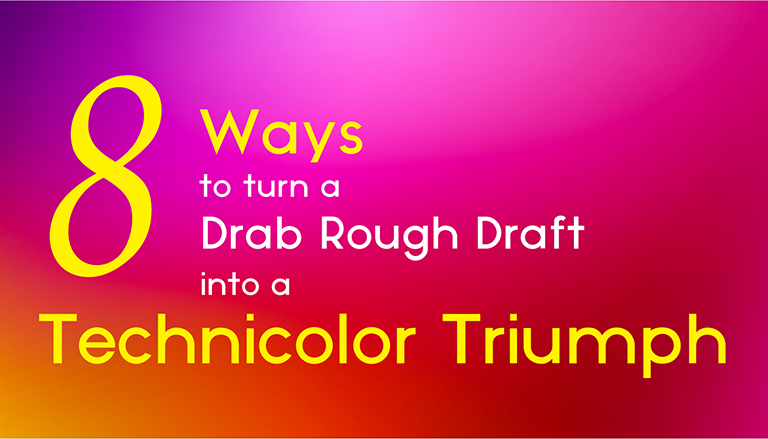
After those rough ideas take on shape and form, she starts splashing on vibrant hues to bring the work to life. Once you’ve drafted the important information, consider fresh ways to incorporate the following techniques.
Use contractions to write like you talk.
Many writers use a more formal style for their initial drafts. By going back over them, you’ll not only improve your copy, you’ll eliminate wordiness and make writing tighter. For example, turning “Ashley is walking toward the car” into “Ashley’s walking toward the car” quickens the pace.
Replace passive verbs with strong active verbs.
Instead of telling the action in boring prose, using active verbs shows it. “Ashley rushed toward the car” creates a sense of urgency and entices the audience to keep reading to find out why.
Be specific with details.
Using specificity takes “From the time my great-nephew was two, I watched him imitate his dad” to “At his second birthday party, my great-nephew imitated his dad while using a toy chain saw to cut imaginary trees.” The word “it” can often be exchanged to add description. For example, “Hope it is fabulous” turns into “Hope your special day is fabulous.” That detail adds warmth.
Eliminate useless words.
A little thought can turn “It was after dinner and the men were sitting in the bar drinking coffee with cognac” into “After dinner, the men adjourned to the bar for cognac and coffee.” “It was” and “were sitting” use a passive tense that doesn’t move the action forward. Creativity draws the reader in by showing movement. Words like “that” and “to” can often be eliminated.
Don’t start sentences with names or pronouns.
An esteemed EPA editor once taught at a writer’s conference that he did his best to never start a sentence with “I.” Sentences that start with a pronoun or a person’s name usually involve telling instead of showing. “Matt walked his dogs toward the park.” Better: “Heading for the park, Matt commanded his dogs to heel.”
Vary sentence length.
Using the same number of words for one sentence after another is monotonous. “Matt walked his dogs. They obeyed his commands. That earned a treat.” Better: “‘Heel,’ Matt commanded. The dogs obeyed earning a treat.”
Vary paragraph length.
Counting sentences in a paragraph can make prose “pop.” Instead of three paragraphs using four sentences each, play with turning them into a four-sentence paragraph, a two-sentence paragraph, a three-sentence paragraph, and a one- sentence paragraph or some other mix. For an example, you might count a few paragraphs in this article.
Put your most important point at the end of a sentence, and at the end of a paragraph.
“Paul studied Scripture, talked to the Lord, and received instruction from others who knew Him well before starting his public ministry.” Better: “Before starting his public ministry, Paul studied Scripture, talked to the Lord, and received instruction from others who knew Him well.” Ending with the most important point maximizes the take-away.
Learning to separate the creative and analytical processes helped the scientist and philosopher/theologian become much more excited about their writing projects. Sketching out the data, then bringing in the depth of color that provide nuanced dimensions made the process far more enjoyable. Cultivating those skills may be even more important with nonfiction than fiction because it turns facts into fascinating prose that takes readers on a journey.
Explore these techniques further with Pulitzer Prize winner Jon Franklin’s book, Writing for Story: Craft Secrets for Dramatic Nonfiction. Recommended for decades, it’s still relevant today for presenting technical details in a way that intrigues readers.
Gary Provost’s book, Make Every Word Count: A Guide to Writing that Works—for Fiction and Nonfiction is another timeless masterpiece for writers and editors.
An EPA award-winning freelance writer and editor, Patti Townley-Covert is the author of The Windblown Girl: A Memoir about Self, Sexuality, and Social Issues. Patti’s written numerous magazine articles for national and international publications. She blogs on her website at ptcovert.com and is currently working on an historical fiction series, “Chronicles Of Choice.”
Posted March 1, 2026