
Are You Barnes & Noble or Borders?
By Tyler Sansom
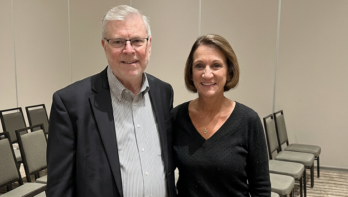
In May, I had the opportunity to speak at the Evangelical Press Association convention in Nashville on a topic I’ve been thinking about for a long time: Are You Barnes & Noble or Borders?
The workshop went well, and honestly, one of the best parts was the follow-up conversations it sparked afterward.
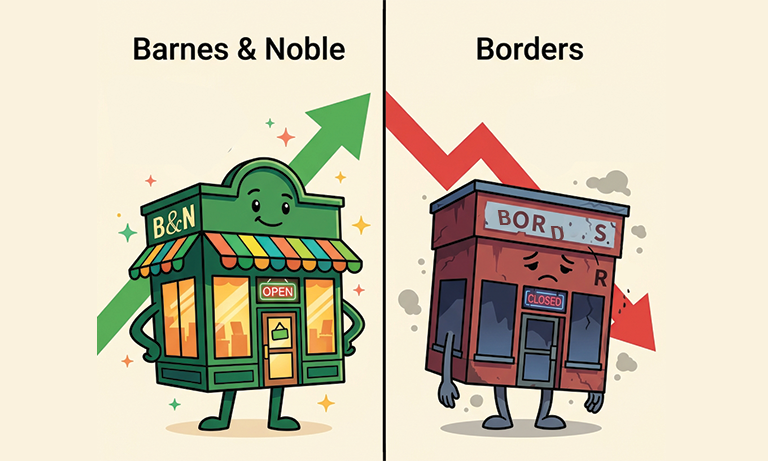
The core question was simple: Why did Barnes & Noble survive while Borders collapsed?
At first, that sounds like a business question. Or a retail question. Or just a bookstore question.
But I think it is a question every Christian media outlet, ministry, church, filmmaker, publisher, and communicator needs to wrestle with.
Borders didn’t disappear because people stopped caring about books. People still read. People still wanted stories. People still wanted places of discovery. But the way people discovered, purchased, trusted, and returned to those stories changed.
Borders treated that shift like a distribution problem.
Barnes & Noble rediscovered the deeper thing it was always supposed to be: a place of discovery, curation, trust, and community.
And I think there is a massive lesson there for Christian medias and ministries.
What’s the challenge?
The biggest challenge today is not simply, “How do we get more views?”
The deeper question is: Are we building a trusted place people return to, or are we just renting attention from platforms that do not share our mission?
Facebook is useful. Instagram is useful. YouTube is useful. Podcasts are useful. Newsletters are useful. Streaming platforms are useful.
But none of them are the mission.
They are tools.
What’s the danger?
The danger is when we confuse access with relationship.
A viral post is not the same thing as trust. A follower is not the same thing as a formed audience. A view is not the same thing as discipleship. A download is not the same thing as loyalty.
The algorithm is not just distributing content. It is discipling desire. It is training people in speed, outrage, distraction, comparison, suspicion, and constant reaction. Before Christian media organizations and ministries ever reach the audience, the platform has often already been forming them.
We cannot simply ask, “How do we get into the feed?” We must ask, “What kind of people are we helping form?”
Every headline teaches something. Every story frames reality. Every platform shapes expectations. Every piece of content either deepens trust or slowly erodes it.
A big question
And one question I keep coming back to is this: If someone consumed our outlet, our films, our podcast, our publication, our church content, or our media consistently for five years, what kind of Christian would they become?
That question has been sitting with me.
In my own work, I’ve seen this play out in several ways.
With Learning You, our newest film, we weren’t just trying to release a movie. We were trying to build a pathway. The film gave us a way to help families, churches, and communities better understand people in the special needs community. The goal was not just that someone would watch a film. The goal was that the story would enlarge their capacity to love people different than them.
With I Can, a movie we released in 2023, we saw something else happen. It started as a movie. But over time, that story created a burden, that burden created a mission, and that mission eventually became The I CAN Foundation. That taught me that the most powerful stories don’t just gather attention. They create responsibility.
And, with Church Anywhere, a ministry that we started at our church that uses digital means to plant expressions of church worldwide, we’ve had to wrestle with the difference between distribution and incarnation. The goal is not just, “How far can this message travel?” The deeper question is, “Where does this message take root, and how do we build God’s kingdom where it does?”
Church Anywhere is not about building a crowd around centralized content. It is about building trusted communities, leaders, and partners who carry the mission into the places people actually live.
That’s what I think Christian influence has to recover.
Not just reach. Rootedness.
Not just attention. Trust.
Not just consumption. Participation.
Not just content. Formation.
Borders is the warning. Barnes & Noble is the invitation. Borders reminds us that beloved institutions can disappear when they mistake yesterday’s model for tomorrow’s mission. Barnes & Noble reminds us that surviving the digital age does not require us to become more frantic, more algorithmic, or more reactive. Sometimes it means becoming more human. More curated. More trusted. More local. More faithful to who we were called to be in the first place.
The mission
The mission has not changed. Truth still matters. Beauty still matters. Discernment still matters. Story still matters. The church still needs faithful voices.
But the machinery has changed.
And if we are not careful, we can have faithful content and fragile pathways. We can have good theology and bad strategy. We can be right and still fail to cultivate trust.
So, the question is not just, “How many people saw it?”
The better questions are:
Did it build trust? Did it help people discern? Did it invite faithful response? Did it give compassion somewhere to go? Did it form people toward Christ? Did it serve the church? Did it create a pathway from audience to advocacy?
Because audience is not just a marketing category. Audience is stewardship. And the future will not belong to the loudest voice; it will belong to the most trusted guide.
Don’t just chase attention. Build something people trust enough to return to.
Tyler Sansom is a pastor, filmmaker, and creative entrepreneur dedicated to telling stories that connect faith, culture, and real life. He is the founder of First Capital Films and Mauckwood Studios where he develops and produces feature films and original content for both faith-based and mainstream audiences.
Posted August 2, 2026